

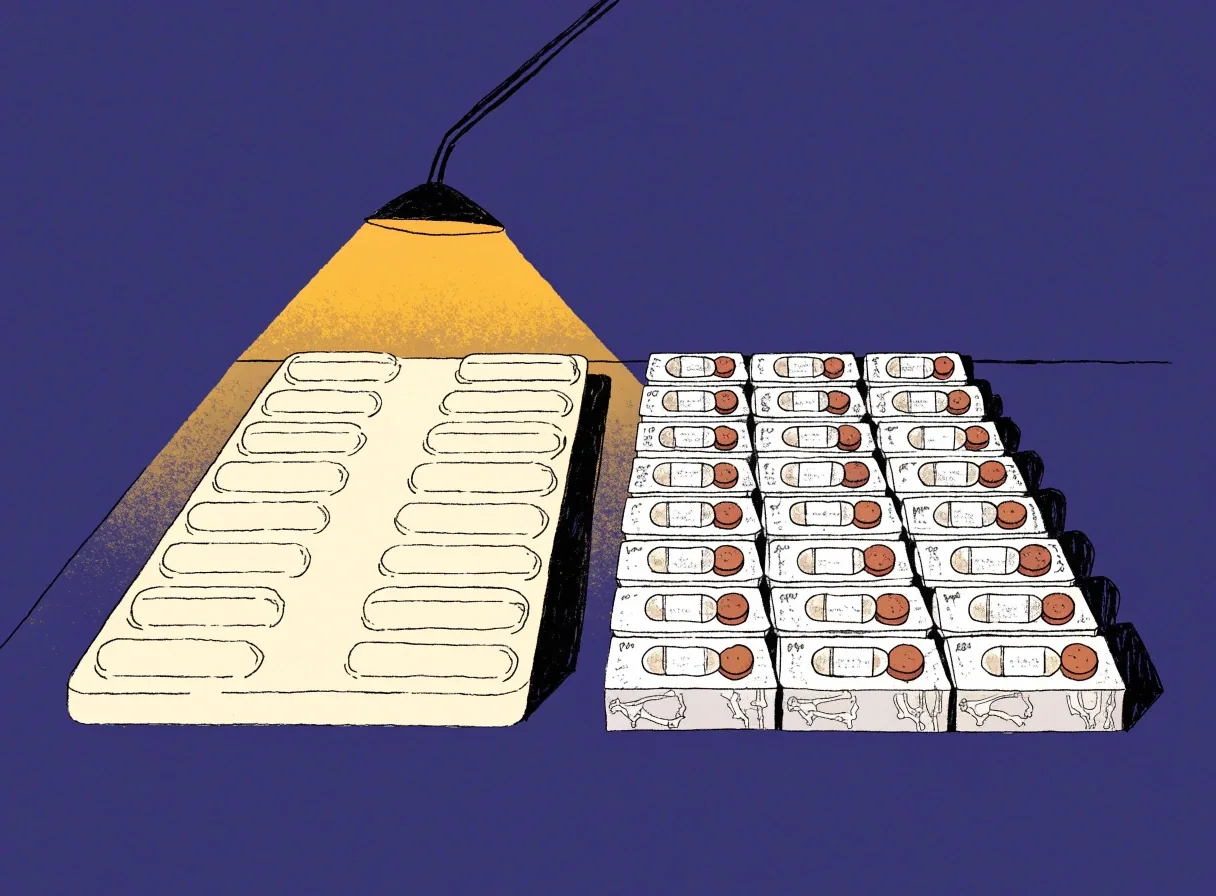
Plain bone label cards laid flat on a workbench with counted capsules and a ruler-edge beside them, lamp light from above-left

Label reading guide

Read the back of the bottle first

Half-turn the capsule. Read what it teaches. The front of a men's vitamin supplement pack is written by marketing — the back is written by regulation, and it is the more useful half.

The first number

Servings per pack before anything else

Find the serving size first. It sits near the nutrition panel and tells you how many capsules or tablets count as one serving. Then divide the total count by that number. Until you have this number, price comparison is meaningless, and this is the step most shoppers skip.

60-capsule blend
At two capsules per serving that is 30 servings — one month at one serving a day.
30-tablet multivitamin
At one tablet daily that is 30 servings — the same month, a different count on the front.
Two identical packs
Different serving sizes can hide a two-to-one difference in cost per day. Read the count, not the pack.

The same logic holds for a men's vitamin supplement bought by the bottle, for a mens multivitamin format bought by the pack, or for a "natural capsules for strength and vitality" blend bought by the month. The units change; the arithmetic does not.

A daily-dose pack beside counted capsule halves on a matte indigo workbench under warm lamp light

Count the capsules out once. The pack tells you what the front quietly leaves out.

The same vitamin, twice

Why the same vitamin appears twice

Vitamin D appears as D2 or D3. Magnesium appears as citrate, oxide or glycinate. Vitamin E may be listed as mixed tocopherols or as a single form. The label names the form because different forms behave differently — a formula that lists a specific form is telling you more than one that does not. You do not need to memorise the chemistry; you need to notice when a label is specific and when it is vague.

Named form

"Vitamin D3 · magnesium glycinate · mixed tocopherols"

The formula names the specific form. You can look up what each of those forms tends to carry, whether the amount suits a daily routine, and whether it matches other entries on the same panel. This is the label you read further.

  • Every active row names its form
  • The vitamin and mineral entries stay comparable
  • What is written is what a regulator saw

Vague form

"Vitamin D · magnesium · vitamin E"

Same nutrient names, no form named. Nothing illegal sits there — plenty of sound products list nutrients this way — but the label has left the comparison open, and you have to work harder to make it. It is worth noticing.

  • Nutrient named, no form named
  • Comparison requires more digging
  • Read further only if the rest of the panel earns it

Extract ratios

Botanical extract ratios and what they mean

Herbal ingredients are frequently listed with a ratio, such as a 10:1 extract — how much raw plant material went into the concentrated extract. Ginkgo biloba and Panax ginseng often appear this way inside multi-ingredient capsule formulas.

A ratio is not a dose and does not by itself tell you whether the amount is meaningful. What it does tell you is that the manufacturer specified an extract rather than listing raw plant powder — a small signal of a more considered formula.

Ratio listed

Ginkgo biloba

Listed as a 50:1 extract — the pack states a concentrated extract, not raw leaf powder.

Read: a specific extract was chosen.

Ratio listed

Panax ginseng

A 10:1 ratio states how much raw root went into the extract. The amount, though, is what counts.

Read: ratio is a signal, not a dose.

No ratio

"Botanical blend"

The entry names a blend but labels no extract and no ratio. You can still compare it — you just have less to compare.

Read: the label chose not to specify.

Where the rest of the label helps

A ratio is a pointer, not an answer. Once you have read the ratio, three other lines on the same pack matter more: the total botanical amount per serving, whether the extract is standardised (a percentage on the entry rather than a raw ratio), and whether anything in the "other ingredients" line is something you react to. The Ingredient Library on this site explains each entry — botanical, mineral, softgel — so a name on the back of the bottle becomes a real comparison point rather than a vague promise.

Below the actives

The other ingredients line

Below the active ingredients you will find the excipients: capsule material, anti-caking agents, sometimes colouring. These lines are long and rarely interesting, but two things are worth checking.

  1. 1

    Is the capsule gelatin or plant-based?

    This matters if you avoid animal-derived ingredients — a strictly plant-based capsule is usually named as such. The line was written for the minority who need it; look for it once and you will know.

  2. 2

    Is anything on the list you know you react to?

    A preservative, a colourant, a filler. The Ingredients row is not a warning sign in itself; what matters is whether the list contains something you have already identified as unsuitable for you.

The rest is standard manufacturing, and its presence is not a warning sign. A capsule needs a shell, a powder needs to flow, a tablet needs to press cleanly. Give the row sixty seconds; you rarely need more.

Provenance, not score

Import and registration notes, read plainly

Imported products carry documentation notes on the pack: the origin, the local distributor and the registration reference. Read them as provenance, not as a score.

Line 1

Origin

Which country the product was manufactured in. Useful when you want to compare against a source you already trust.

Line 2

Local distributor

A named Indonesian business that has taken the product through import. An accountable name, not a middleman footnote.

Line 3

Registration reference

A reference shown on the pack, meaning the product entered through a documented channel. It is a channel check, not a quality mark.

Line 4

Local product

A local product with clear labelling can be just as sound as an import. Read the same lines; judge the same way.

A registered import tells you the product entered Indonesia through a documented channel and that someone local is accountable for it. That is genuinely useful information. It says nothing about whether the formula suits you — and a local product with clear labelling can be just as sound.

Heat, humidity, time

Storage instructions on the pack

In a tropical climate this line earns its place. Most capsules want a dry, cool cupboard, away from direct sun and away from the bathroom. Some softgels specify tighter conditions. If the pack gives a storage instruction, follow it — heat and humidity affect gelatin capsules and fish oil softgels more than they affect hard tablets.

A product stored badly for three months is not the same product you bought.

Format What the pack usually specifies
Hard tablet Dry, cool cupboard. Usually the most forgiving of the three to a warm room.
Hard capsule Dry, cool cupboard, lid closed. Gelatin shells soften in humid air, so keep the desiccant in the pack.
Softgel Away from direct sun, tighter temperature. Fish-oil softgels are the most sensitive to a bathroom shelf.

Read further

Questions the pack cannot answer

Can I trust an import more than a local product?

Not by itself. A registered import tells you the product entered Indonesia through a documented channel with a named distributor. That is useful for provenance, but it says nothing about whether the formula suits your routine or your diet. A local product with clear labelling can be just as sound.

Do I need to understand every botanical ratio?

No. Notice when a ratio is given and when it is not. A ratio confirms an extract was specified; it does not tell you what amount you are getting. Use it as a signal that the manufacturer made a considered choice, and read the total botanical amount per serving for the rest.

The excipients list is long — is that a problem?

Not by itself. Every capsule needs a shell, every powder needs to flow. Check two things: the capsule base (gelatin or plant-based) and whether anything on the list is something you know you react to. Everything else is standard manufacturing.

Do it once, well

Comparing two labels in sixty seconds

Put two bottles of men's vitamin supplements side by side and run the same four checks. Sixty seconds is enough to eliminate most of the wrong options, and it works on multivitamins, single-ingredient capsules and long botanical blends alike. Do it once and the second comparison takes half the time.

  1. 01

    Servings per pack

    Total count divided by serving size. Without this number, price means nothing.

  2. 02

    Ingredient present, in a named form

    The nutrient you came for is on the panel, and the label named the form it uses.

  3. 03

    Botanical entries, ratio or none

    Extract ratios make the blend readable. A blend with no ratio still compares — you just have less.

  4. 04

    Storage and import notes, clear or hidden

    A serious pack names its storage line and its import reference. A quiet pack usually means someone skipped a detail.

Labels are regulated documents, and regulated documents have limits. They will not tell you whether a formula suits your diet, your training or your week. That judgement is yours — and the rest of this site exists to help you make it. Read the label first; then read the context. Together they answer most of what a shopper actually needs.

A dark shelf wall under a single warm lamp pool, the workbench cleared for the evening

Read a label yourself

The back of the bottle is the honest half

Bring the pack you are considering, and use this page as a checklist. Servings first, then forms, then ratios, then import and storage. Four checks, done in order, tell you more than any front-of-pack claim ever will. If something on a label still reads as unclear, ask us directly — the shelf has a stack of examples, and we are happy to walk through yours.

Shelf note

This page keeps a small note on your visit

Cookies keep the course shelf in order — which chapter you reached and what you already read. Nothing is sold on. Mark the boxes as you prefer.

Read the full shelf note